
One set of books has taken up the entire first half of 2024: the colossal autobiographical novel series Min Kamp (My Struggle), by the Norwegian author Karl Ove Knausgård (rendered in English as ‘Knausgaard’). It’s the biggest reading project I have undertaken since reading Moby Dick in 2019, and one of the most satisfying literary experiences of my life.
Originally published in as six books in quick succession more than a decade ago (2009-2011), the experience of reading about the minutiae of a man’s everyday life is remarkably compelling from the first page. It received near-universal critical acclaim at the time and produced numerous controversies in Knausgård’s home country, including a lawsuit against its very publication by his own uncle. The sometimes-brutal honesty it is so well known for doesn’t feel intentionally provocative to me, but rather adheres to Knausgård’s professed aim to write something as close to real life as is possible.
I think he is largely successful in this. Sometimes – as when, at various points across the books, Knausgård relays his frustration with his wife and children, confessing the impossibility of either staying or leaving – you wince at what you are being made privy to, as though overhearing something deeply personal that wasn’t intended for your ears. You are all the time aware that there is another side to these complaints that you are not getting, and though you sometimes recoil from the author’s views, the world Knausgård creates is all-encompassing. The result of all this honesty, unspooled across numerous pages in thrilling, mundane detail, is a feeling for the reader of being drawn in to the cadence of the everyday, and of bearing witness in real time everything from the indignities of kids’ parties to cleaning up the house after a relative as died. It’s writing that moves at the pace of life, with feelings written up raw and in the moment, without any of the softening that added context or the passage of time would lend them. And all this from a writer whose national culture is known, at least by foreign residents, for its stoicism, reticence, and almost impenetrable sense of privacy. I have never met a Norwegian who expresses themselves like Knausgård.
Knausgård often goes about this by focusing on the body, on what it is doing in a given moment. Is it sitting on the balcony with a cigarette? Is it feeling the rumble of hunger? Is it moving at pace towards the nursery to collect the children? Despite his intense interest in art and literature, and several meandering excursions into both, My Struggle is a project intensely committed to the material – to not trying to rise above the realities of embodied experience through words. “That was the feeling I had: the world was vanishing because it was always somewhere else, and my life was vanishing because it too was always somewhere else,” he explains in book six, on the subject of his writing philosophy for the novels (p.403). He goes on,
“If I was to write a novel it would have to be about the real world the way it was, seen from the point of view of someone who was trapped inside it with his body, though not with his mind, which was trapped in something else, the powerful urge to rise out of such fusty triviality into the clear, piercing air of something immeasurably greater. Ascent was art, fiction, abstraction, ideology; confinement was in the world of things and bodies, the material soon-to-be-rotting universe all of us comprise. That was the idea, or the urge: reality.”
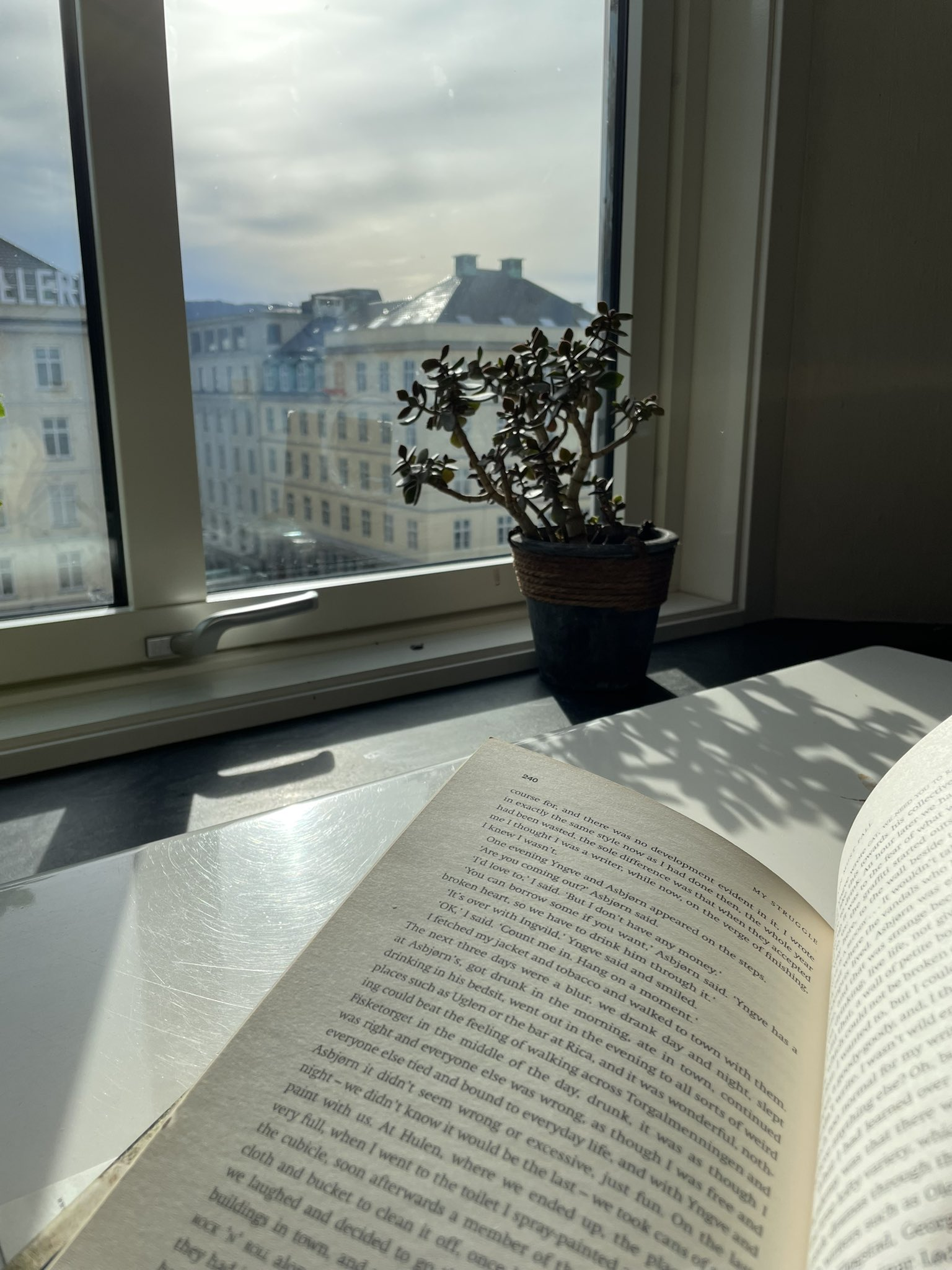
The second and fifth books were unquestionably my favourites, although book six was also immensely satisfying and contains some of the most memorable scenes of the whole series. Book one remains memorable for kicking off the whole project and introducing the key themes of death, family, and Knausgård’s persistent feelings of insecurity over whether he is good enough. I had the experience of reading book five, which documents Knausgård’s 11 years in Bergen, in that very city, looking out across Torgallmenningen from the sunny living room of my new flatshare. Similarly, Knausgård’s year in the north of Norway had echoes of my own summer and winter spent in the Norwegian Arctic, not too far from the town in the novel; and I visited Stockholm twice just after reading the second book, which mostly takes place there. Aligning books with place always deepens the grooves of association. I recognised many of the places in Bergen Knausgård frequents, including Café Opera and the student radio centre where I have recorded podcasts with guest researchers. However, it is striking that the famous mountains of Bergen get not a single mention except as a partial explanation for why it rains so much (the mountains create their own microclimate, essentially trapping rainclouds over the city). In my experience, easy access to the mountains is one of the main reasons that many residents love and continue to live in Bergen, in spite of the weather; yet it seems they made no impression at all on Knausgård.
This leads me to my next point. Nature is described in sometimes beautiful detail in My Struggle, for instance the Vestland region where his mother grew up, or passages about the windswept north. But for the most part, nothing of this is romanticised, and it doesn’t actually feature that much in his life; Knausgård’s childhood, spent making up games in drab, rubbish-strewn woods, running for the last bus, cycling around aimlessly, and avoiding the scary older kids who hang out at the town’s only shop, is actually quite recognisable to me as someone who grew up in small-town England. In other words, the picture My Struggle paints is not one especially reminiscent of the Norway of many people’s imagination. Even if much of it was spent outside, it is a childhood more defined by asphalt and boredom than wholesome friluftsliv (the Norwegian word that encapsulates love for the outdoor life). Knausgård almost never goes skiing, fishing, or hiking, for example. The drama of nature that is so deliberately evoked as to serve as a character in many other Norwegian novels (see: Hamsun’s Pan, Per Petterson’s Out Stealing Horses, Roy Jacobsen’s The Unseen, Terje Vessås’ The Ice Palace) is nowhere to be found in My Struggle.
Finishing My Struggle – or actually, starting it – thus also represents another transition for me, namely the end of a particular kind of relationship to Norwegian literature. If you had asked me four years ago to pick representative books, I would have landed on relatively short novels that mostly concern rugged mountains and tiny towns with nature-based economies, with few people and even less dialogue: sparse, or sparing, in both form and content. But from the very beginning of My Struggle, I could feel that this was not Knausgård’s way. His is a world of verbose passages, and conversation, lots of it. The English translation of the entire series comes in at over 3,700 pages. I began reading it just after Christmas, and finished it at the beginning of July.
Book six, coming in at 1,200 pages, is more reflective in tone and looks back on the impact of publishing the volumes, including Linda’s deepening depression and the threats from uncle Gunnar. There are some lovely lines in it, which I’ll gather here:
“Geir gave me the chance to look at life and understand it, Linda gave me the chance to live it. In the first instance I became visible to myself, in the second I vanished. That’s the difference between friendship and love.” p.243
“Linda has stars inside her, and when they shine, she shines, but when they don’t the night is pitch black.” p.1025
As someone who’s been visiting Norway since 2017, and now having lived here for two years, I also found the passages comparing Norwegian and Swedish culture extremely interesting:
“To be Swedish is also to possess something else, something alien to me, which is social adroitness. The ability to talk about matters great and small in a personal way without ever getting personal, which Swedes master to perfection, is something at which I am utterly inept; either I blurt out something so private that people look down or become ill at ease, or else I go on about something so remote from myself that everyone else quite naturally is bored to death. There is a colloquial elegance about Sweden that is collective and very much a part of the social world, something sophisticated and impressive, quite absent in Norway, where such casual refinement is always individual, attaching to those who have been fortunate, either in something they’ve just said or in their lives altogether.” p.248
I also found both the final pages and the scenes before the interlude, where a pregnancy is announced and the family go for an imperfect picnic where ladybirds swarm ominously, perhaps the most deeply moving of the whole series. The book would have worked very well if it had continued like this, without its subsequent 500-page stray into Paul Celan’s poetry and Hitler’s childhood. Initially I was annoyed to be wrenched away from the usual tone of My Struggle – is he really going to make me read about Hitler for 500 pages? – but it gradually came to hypnotise me as well. While parts of the analysis feel strained, washing over me without making much of an impact, as someone who knew very little about Hitler’s personal life before this, I found myself morbidly interested the picture Knausgård builds of his psychological profile.
In this segment, what strikes me most is that Knausgård’s observations about democracy now read as quite naïve, as though completely from another time. He could not have predicted the demolition of democratic institutions that would come in the years that followed the publication of book six in its original Norwegian (2011), from Brexit to Trump in 2016 (and now probably 2024 too), to the ongoing surge of right-wing populism that has taken root in France, Hungary, the Netherlands, Poland, Germany, and many other countries. What Knausgård takes to be self-evident – that our era of relative peace, stability, and democracy are stifling, even emasculating, in all their pacifying security, keeping us from what is “real” – reads as outdated and even complacent now. Russia’s war against Ukraine has given rise to serious talk in many European countries of a need to reinstate national service and conscription. Suddenly, war on this continent doesn’t seem so unthinkable, the real seems closer, and his descriptions of Hitler’s peculiar, dark charisma and his disturbing ability to connect with a crowd seem less a historical phenomenon than something recurrent and contemporary: out of context, the breathless quotes from Hitler’s impressed contemporaries could be describing a Trump rally. In this sense, My Struggle reads as a cultural artefact composed in a radically different era.
Returning to the personal, I think it also matters that I am at an age where the trivialities of family life remain part of a potential future, rather than my life today. It’s possible to imagine millions of middle-class parents nodding along at descriptions of the tedium of taking care of children, even if they are shocked by Knausgård verbalising such things. Of course, female writers like Rachel Cusk (in A Life’s Work, 2001) have addressed such ‘taboo’ topics too. But it pays to remember that although My Struggle found universal appeal, Knausgård is writing from a context far outside the cultural Anglosphere: Norway and Sweden are child-centric cultures with strong gender equality norms, where not taking up one’s right to several months’ paid paternity leave would be looked upon as strange. Knausgård’s humiliation, resistance to, and self-deprecation about the rituals of public fatherhood – most memorably, at a children’s circle led by a young woman in which they are encouraged to sing and dance – read differently in these contexts, as does his resentment over his perception that his wife Linda does less housework than him. This is not a complaint about the financial difficulties of family life, or whether they can afford childcare so Linda can work – that is taken care of by the generosity of the Swedish state. It is more to do with the division of labour within the couple, who has a right to freedom and time by themselves, and the more subtle ‘feminisation’ process Knausgård feels himself to be subjected to whenever he must partake in certain activities with the children. For me, these are fascinating subjects, and reveal something about where debates about gender equality go once the most egregious injustices have been erased. Living in Norway one sees how these conversations take a different shape when the financial obstacles that would afflict families in the UK, for instance, are largely gone. Knausgård doesn’t dwell on policy or politics, but the personal politics raging inside his own relationship are possible in large part because family-friendly policies have been so successful in Sweden.
So, where to go from here? I badly didn’t want to finish these books; as the Norwegian summer swells around me, I have a strong desire to go back and start them all over again. I have been late to this phenomenon, but I think it served me well to read them here, in this country, at this age. Knausgård now lives in London, and the children described in My Struggle are approaching adulthood. While the intervening years may make the books read a little differently now, the immediacy of the descriptions still sucks you into a vivid present that you become greedy for more of. I will now begin the sad process, one that comes with finishing any great work of literature, of weaning myself off it.
 no cash on the highway
2 thoughts on “Reading Knausgård’s My Struggle series in 2024”